 Piece of Cake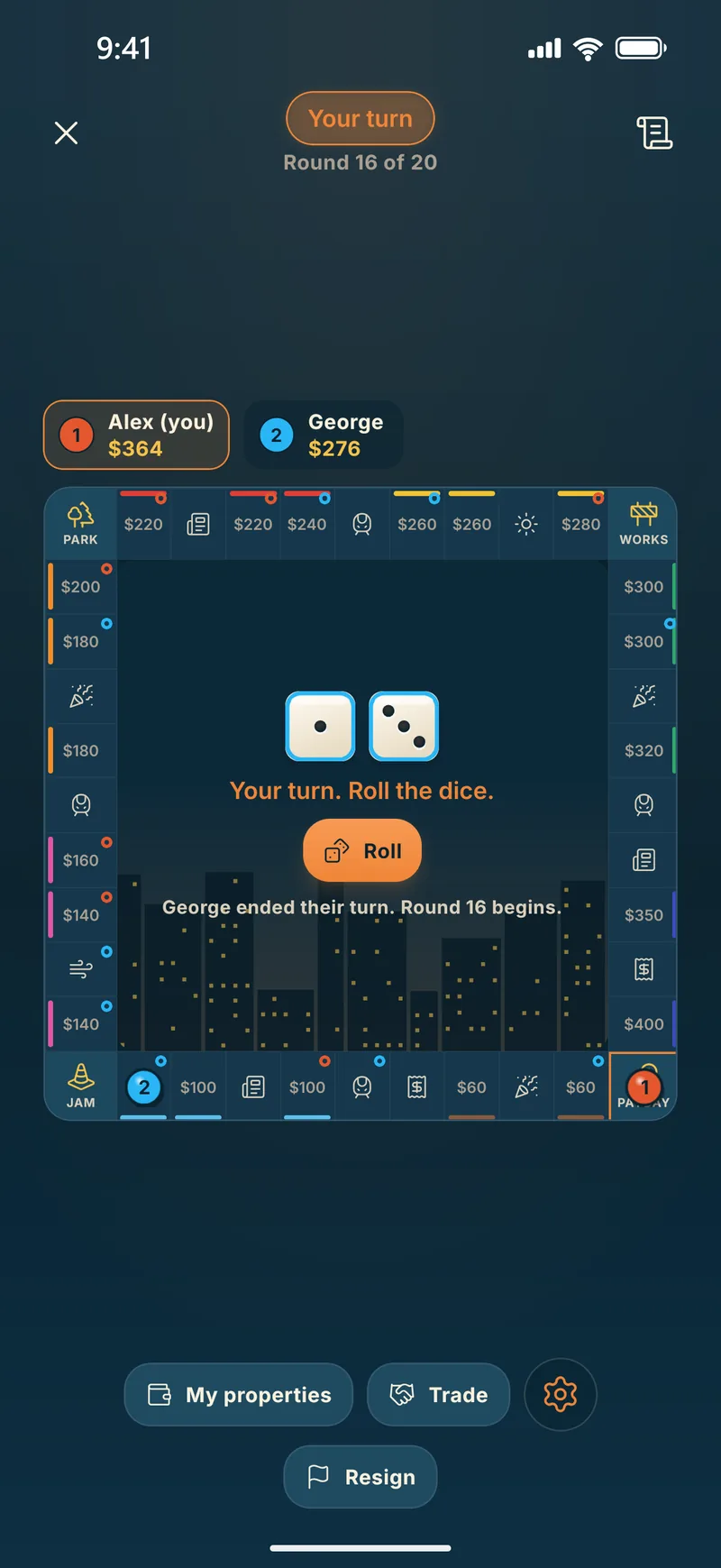
How to play Moguls
Roll round the city, buy up whole districts, build homes and towers, and collect rent until everyone else is broke — or be the richest when the rounds run out.
Goal
Be the last mogul standing, with everyone else bankrupt. If the table has a round limit, the game ends when the last round is complete and the richest player wins. Your net worth is your cash, plus the price of every square you own (half if it is mortgaged), plus what you paid for your buildings.
Setup
Two to twelve players. Seats are shuffled and seat order is turn order; every seat gets its own token colour. Everybody starts on Payday with the same cash — $1,000, $1,500 or $2,000, chosen when the table is set up.
Taking a turn
Tap Roll to throw two dice and move that many squares round the board. Each time you pass or land on Payday you collect $200. Deal with the square you land on, then manage your squares, offer a trade if you like, and tap End turn.
Doubles
Roll a double and you take another turn once your move is done. Roll three doubles in a row and you are sent straight to the Traffic Jam without moving, and your turn ends.
Buying
Land on a street, a station or a farm nobody owns and you may buy it for its price. Pass, and it stays unowned — there is no auction. You need the cash in hand to buy.
Rent
Land on a square someone else owns and you pay them rent straight away. A bare street charges its basic rent, doubled when the owner holds the whole district and nothing is built on it; with homes or a tower the rent climbs steeply. Stations charge $25, $50, $100 or $200 for one to four stations owned. The Wind Farm and Solar Park charge 4 times your dice, or 10 times if one player owns both. Mortgaged squares charge nothing.
Districts and building
Own every street in a district, with none of them mortgaged, and you may build on your own turn. Build evenly: a street may only get its next home when no other street in the district has fewer. Four homes on a street can become a tower. Selling works the same way in reverse, and a building sells back for half what it cost.
Mortgages
Mortgage a square with nothing built in its district to raise half its price. A mortgaged square charges no rent. Paying it off costs the mortgage plus 10%.
Headline and Block Party
Land on a Headline or Block Party square and the top card of that deck is turned over for everyone to see. It might pay you, charge you, move you or send you to the Traffic Jam. A Green Light card can be kept, traded, and played to leave the Traffic Jam for free.
The Traffic Jam
Land on Road Works, roll three doubles, or draw a card that says so and you are sent to the Traffic Jam without collecting $200. To leave, pay the $50 toll or use a Green Light card before rolling, or try to roll a double: a double moves you out by that roll, but gives no extra turn. After three failed tries you must pay the toll and move. Just passing through the Traffic Jam costs nothing.
Taxes and the park jackpot
Council Rates cost $200 and the Parking Fine $100. With the park jackpot switched on, every tax, toll and card payment to the bank goes into a jackpot instead, and whoever lands exactly on City Park collects it. Otherwise City Park is just a rest.
Trading
On your turn you can offer any other player a deal: cash, squares and Green Light cards in either direction. Squares in a district with buildings on it cannot be traded. Bots answer at once; a person answers on their own screen, and you can withdraw the offer while you wait. Mortgaged squares change hands still mortgaged.
Owing money
If you owe more than you have, sell buildings and mortgage squares until you can pay, then tap Pay. If you still cannot, declare bankruptcy: everything you own goes to whoever you owe — or back to the bank — and you are out of the game.
Resigning
Resigning counts as going bankrupt to the bank: your squares go back on the market and everyone else plays on. With two players it hands your opponent the win. Leaving a game in progress does the same.
These are the rules Piece of Cake plays, word for word: the same rulesheet is in the app under Help → Moguls. Every roll, deal and move is checked on our servers, so nobody can bend them.
Other board games in the same subscription: Chess (2 players, about 10–60 minutes); Checkers (2 players, about 10–30 minutes); Reversi (2 players, about 10–25 minutes).